
How Does an Air Conditioner Work? A Practical Guide for Qatar
With summer temperatures often passing 40°C and high humidity along the coast, an air conditioner is a necessity in Qatar, not a luxury. It keeps homes, offices, shops and villas comfortable through the longest and hottest months of the year. But how does an AC actually produce cool air?
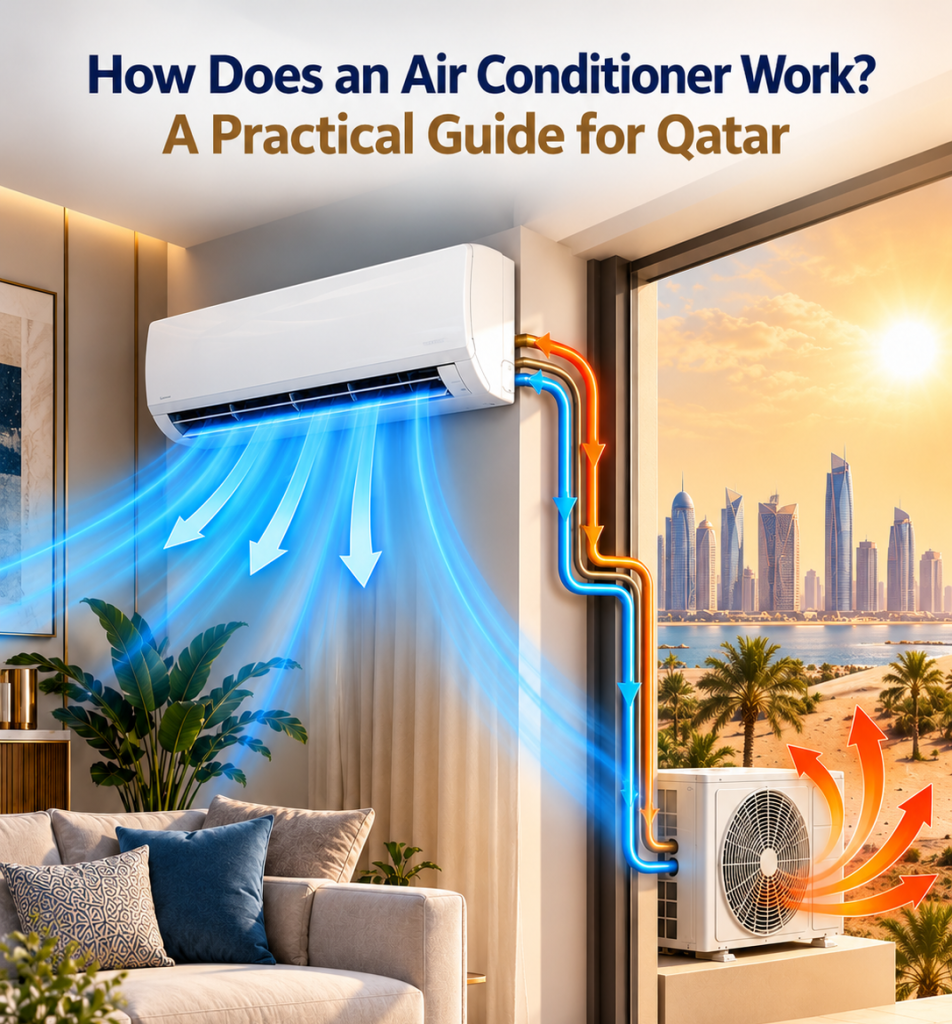
An air conditioner doesn’t actually produce cold air. It removes heat from indoor air and releases it outside, using a continuous refrigeration cycle made up of a few key components.
Knowing how this cycle works helps you choose the right system, maintain it properly, and judge which is the best air conditioner in Qatar for your space. It also makes it easier to compare AC brands in Qatar on features that matter rather than on name or price alone.
How Does an Air Conditioner Produce Cool Air?
An AC uses a refrigerant, a special fluid that absorbs and releases heat as it changes between liquid and gas. The refrigerant moves continuously through a closed system connecting the indoor and outdoor units.
Inside the room, a fan pulls warm air across a cold coil. The refrigerant absorbs the heat, and the cooled air is blown back into the room. The absorbed heat is carried outdoors and released. This repeats until the room reaches the temperature set on your thermostat, and then the system adjusts its output to hold it there.
The cycle has four stages: evaporation, compression, condensation and expansion.
1. The Evaporator Coil Absorbs Heat from the Air Inside the Room
The indoor fan draws warm room air over the coil, and the cold refrigerant inside absorbs the heat. As it does, the refrigerant changes from a low-pressure liquid-vapour mixture into a gas, and the air leaving the unit is cooler.
The coil also dehumidifies. Warm, humid air contacting the cold surface loses moisture as condensation, which drains away through the drain pipe. In Qatar, where humidity can make a room feel sticky even at a moderate temperature, this is a big part of why an AC feels comfortable and not just cold.
2. The Compressor Circulates the Refrigerant Throughout the System
The refrigerant gas then moves into the compressor, which is typically located in the outdoor unit of a split AC. The compressor squeezes the gas, raising its pressure and temperature so it can release heat outdoors. It also keeps the refrigerant circulating.
The compressor is the key part of the system. If it fails or weakens, the AC may cool poorly or stop cooling altogether.
3. The Condenser Releases Heat Outside
The hot, high-pressure gas enters the condenser coil in the outdoor unit. The outdoor fan blows air across the coil, the refrigerant gives up its heat to the surrounding air, and it condenses into a high-pressure liquid.
This is why the outdoor unit blows out hot air while the indoor unit blows cool air: the heat from your room is being moved outside. In Qatar’s heat and dust, outdoor units work hard, so a clean condenser coil and clear space around the unit make a real difference to performance.
4. The Expansion Device Lowers Refrigerant Pressure
Before returning to the evaporator, the liquid refrigerant passes through an expansion valve or capillary tube. This sharply reduces its pressure, which makes it very cold. The cold refrigerant enters the evaporator coil, and the cycle starts again.
Why Does an AC Need Both Indoor and Outdoor Units?
In a split AC, the work is shared between two units: